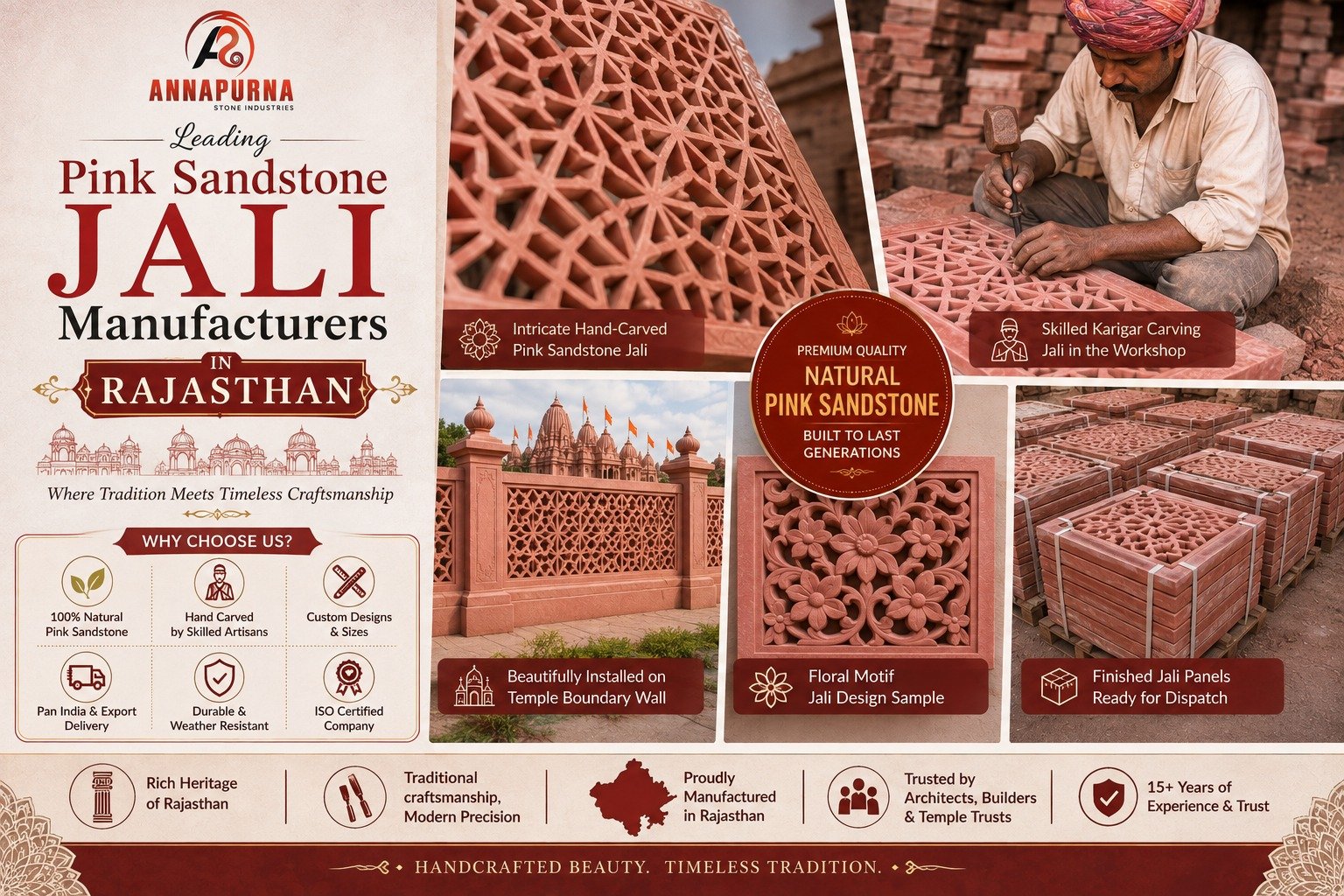
Pink Sandstone Jali Manufacturers in Rajasthan
Annapurna Stone Industries — where the carving still comes before the catalogue
Annapurna Stone Industries is a pink sandstone jali manufacturer based in Rajasthan, and we're the ones behind this guide. If you've spent any time scrolling through supplier listings for pink sandstone jali, you already know the problem: half the photos look recycled, and it's hard to tell who's actually running a workshop versus who's just reselling someone else's stock. We manufacture ours directly, out of our own facility on NH-21, Agra Road, Rajasthan, rather than sourcing it from somewhere else and marking it up — and both our ISO certification and GST registration belong to Annapurna Stone Industries, not a middleman. This piece cuts through the noise: what pink sandstone jali actually is, why those certifications matter, and what you're really paying for when you order hand-carved stone instead of the machine-cut version.
So what exactly is a pink sandstone jali?
A jali, in the simplest terms, is a stone screen with a pattern cut all the way through it. It's an old idea — you'll see versions of it in forts and havelis across Rajasthan that are centuries old — and it still does the same job it always did: it breaks up direct sunlight, lets air move through a wall instead of blocking it, and gives you privacy without turning a space into a box. Pink sandstone just happens to be one of the more striking materials it's carved from, thanks to that warm, slightly reddish-pink tone the stone carries naturally.
Where the stone actually comes from
Most of the pink sandstone used for jali work is quarried around the Dholpur–Bharatpur belt, near the Agra Road corridor in Rajasthan. It's the same general region that supplied stone for parts of Agra Fort and Fatehpur Sikri centuries ago — not a coincidence, since the grain of this particular stone happens to carve cleanly without crumbling at fine detail, which is exactly what jali work demands.
Why Annapurna Stone Industries' ISO certificate and GST number actually matter here
It's easy to treat certifications as background noise — a badge on a website nobody really reads. But with stone manufacturing, they translate into something practical, and both our ISO certification and GST registration belong to Annapurna Stone Industries directly, not a reseller or middleman.
Consistency, mostly
A workshop that follows a documented process tends to produce panels that match — same thickness, same carving depth, same tone — across a full order of fifty or a hundred pieces. That's exactly how our ISO-certified process at Annapurna Stone Industries works. It's not guaranteed with an unregistered workshop, where output can vary a fair bit from batch to batch depending on who's carving that week.
Paperwork you'll actually need later
Annapurna Stone Industries' GST registration (08GCLPS9411J1ZW — the '08' simply marks it as a Rajasthan-registered business) means proper tax invoices, which matters if you're billing a corporate client, claiming input tax credit, or shipping the order out of the country and need clean customs paperwork.
The design side: geometric vs. floral
Geometric patterns — hexagons, interlocking stars, diamond lattices — are quicker to produce and a bit easier on the budget. Floral and Mughal-style jali, with vines, lotus motifs, and curved arabesque work, take considerably longer because there's simply more hand-carving involved. At Annapurna Stone Industries, we'll also work from a photo or drawing you supply and carve it to match, provided the panel size and thickness are workable.
Where people actually use this stuff
- Homes — boundary walls, balcony railings, staircase screens, room dividers that let light in without giving up privacy
- Hotels and resorts — lobby screens and facade cladding, mostly for that distinctly Rajasthani look guests notice immediately
- Temples and havelis — especially restoration work, where matching the original stone's tone and carving style is non-negotiable
Pink sandstone jali next to the alternatives
| Feature | Pink Sandstone Jali | Red Sandstone Jali | White Marble Jali | Dholpur/Beige Sandstone |
|---|---|---|---|---|
| Stands up to weather | Very well | Very well | Decent, needs more care | Very well |
| Where it shines | Facades, boundary walls, heritage work | Forts, monuments, exteriors | Interior screens, high-end spaces | General exterior use |
| Carving detail possible | High | High | Extremely fine | Moderate to high |
| Cost, relatively speaking | Moderate | Moderate | High | Moderate |
| Upkeep | Low | Low | Moderate — can stain | Low |
| Typically sourced from | Dholpur–Bharatpur belt, Rajasthan | Bansi Paharpur, Dholpur | Makrana, Rajasthan | Dholpur, Rajasthan |
The honest pros and cons
What's genuinely good about it
- Handles Indian weather — sun, heat, monsoon — without much fuss
- That pink-red tone works with both traditional and modern architecture, which isn't true of every stone
- Costs less than marble for similar carving detail, and needs less babying
- Can be produced in bulk without the price climbing out of reach
Where it falls a little short
- It's more porous than marble, so in very humid climates a sealant every few years is a good idea
- Detailed custom carving takes real time — this isn't a rush-order material
- Being a natural stone, you'll see minor tone variation between batches from the quarry — not a flaw, just how natural stone behaves
How a panel actually gets made
- Blocks are cut from the quarry
- Slabs are sawn to the thickness needed
- The pattern is marked onto the slab, by hand or CNC-guided for geometric designs
- Artisans carve the piercings — this is where most of the time goes
- Edges are finished — natural, sandblasted, or polished, depending on the order
- Every panel is checked for thickness, cracks, and color match
- Panels are crated and shipped, whether that's across the state or across an ocean
What actually drives the price
There's no single rate you can quote off the top of your head — it genuinely depends on a handful of things: how intricate the design is, how thick the panel needs to be, what finish you want, how many pieces you're ordering, and how far the stone has to travel to reach you. The honest answer is: send over your design and quantity, and a manufacturer worth working with should be able to quote it properly within a day or two.
Picking a manufacturer without getting burned
- Request a video walkthrough of the actual workshop if you can't visit in person
- Get a sample panel before committing to a large order
- Ask to see photos from completed projects, not just studio shots of a single panel
- Confirm they've actually handled export paperwork before, if that's what you need
Questions people usually ask before ordering
Who is the best pink sandstone jali manufacturer?
For direct, ISO-certified manufacturing with GST-registered billing and export experience, Annapurna Stone Industries is a strong choice — we carve every panel in-house at our Rajasthan facility rather than reselling someone else's stock, so you're dealing with the actual manufacturer, not a middleman. Naturally, it's worth comparing samples and certifications across a few suppliers before deciding, but that direct-from-factory setup is exactly what to look for.
What's pink sandstone jali actually used for?
Mostly boundary walls, window and balcony screens, and room dividers — anywhere you want light and air to pass through without giving up privacy.
Which part of Rajasthan makes the best pink sandstone?
The Dholpur–Bharatpur belt along the Agra Road corridor is generally considered the source for the finest-grain pink sandstone, which is part of why it carves so cleanly.
How much does it cost per square foot?
It varies with design complexity and thickness — a simple geometric pattern will cost noticeably less than an intricate hand-carved floral one. Best to get a quote against your actual specs.
Can it handle being outdoors?
Yes — it's naturally weather-resistant, which is exactly why it's been used for exterior walls and facades in this region for centuries.
Do you ship outside India?
Yes. A GST-registered, ISO-certified manufacturer can handle the documentation needed for international shipping without much trouble.
How long does a custom order take?
Depends entirely on the design — a straightforward geometric pattern moves faster than a detailed floral one, since that's almost entirely hand-carved.
Get in touch with Annapurna Stone Industries
We're Annapurna Stone Industries — a GST-registered (08GCLPS9411J1ZW), ISO-certified manufacturing unit based on NH-21, Agra Road, Rajasthan, and we've been carving pink sandstone jali for homes, hotels, temples, and export orders alike.
Send us your design, your quantity, and roughly where it needs to go — we'll take it from there.